

 日本語
日本語
For decades, Japan’s globalization debate has focused almost entirely on one direction: sending people out. Increase study abroad. Rotate managers through overseas postings. Create opportunities to work at foreign firms. Send people to places like Silicon Valley to build experience.
All of these are worthwhile efforts.
But after thirty years in Silicon Valley — and after beginning to seriously evaluate a move back to Japan myself — I have come to believe that this debate is missing something fundamental.
Globalization has to be designed through to the return trip.
This piece starts from a concrete case — one person’s decision to relocate — and works outward to what it means for the circulation of talent and capital into Japan, and ultimately for Japan’s competitiveness.
What Thirty Years Abroad Actually Builds
Live overseas for two or three decades and what accumulates is not just a résumé. Financial assets, retirement funds, investment accounts, property, banking history, professional networks — all of it forms inside the institutional framework of the country you live in.
If you have worked in the United States for a long time, you are paid in dollars and you invest a portion of that in equities, mutual funds, and a 401(k). This is not the behavior of an unusually aggressive investor. It is what the system is designed to produce here in the US — work normally, and this is where you end up.
The friction appears the moment someone with that foundation begins to consider returning to Japan. The first obstacle I encountered was not housing or work, but the complexity of the system itself. Frankly, my reaction was: “Why does this need to be so complicated?”
The Issue Is Not the Tax Rate. It Is the Complexity.
One illustration — offered not as an explanation of tax treatment, but to show the shape of the decision problem. Japanese tax rules state that you calculate any capital gain based on the yen amount at the exchange rate on the date of each transaction — whether buying or selling.
Example: Suppose you buy a US stock for $1,000 and sell it for $800. In dollar terms, that is a $200 loss. But if the exchange rate was ¥100 to the dollar at purchase and ¥150 at sale, the yen-based calculation can show a gain that may be taxable. A loss in dollars, a gain in yen — a result that runs directly against intuition.
Extend that to a mutual fund with two decades of automatically reinvested distributions, and the exercise becomes one of reconstructing acquisition values and historical exchange rates across hundreds of transactions. At that scale, the availability of the records themselves becomes the constraint.
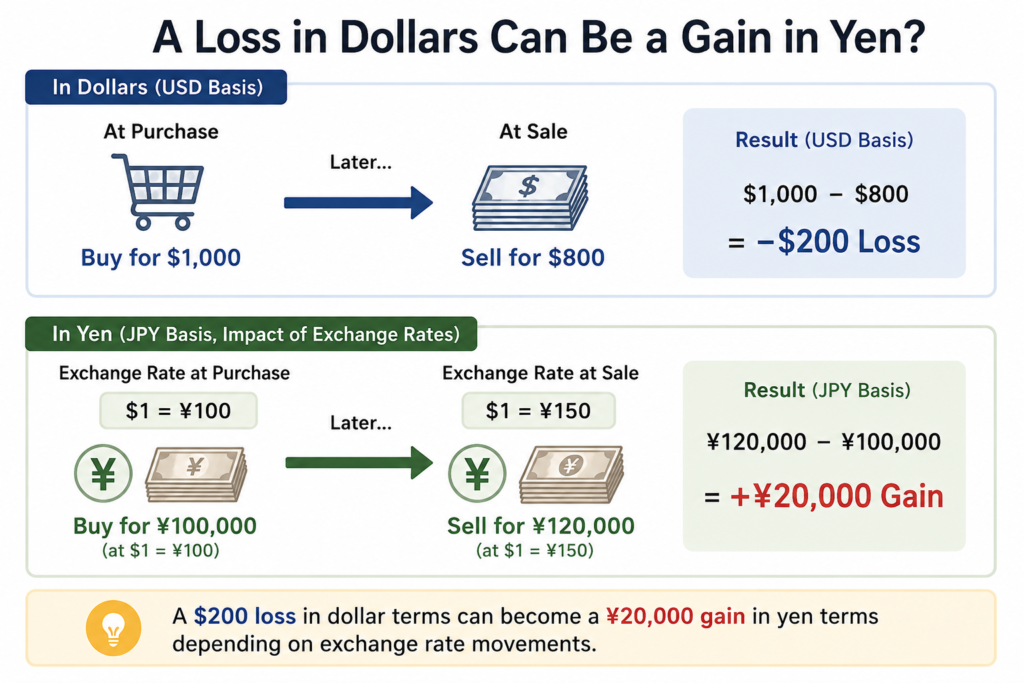
The point here is not whether rates are high or low, but that the compliance cost — the time, expertise, and professional fees required simply to comply — is itself large enough to change behavior.
The deeper issue is predictability. Tax residency in Japan is not as clear-cut as in the United States, where, for most non-citizens, the test is essentially a day count. Japan applies some basic rules of thumb, but the determination is more subjective: they assess whether the person intends to live there. That is institutionally reasonable — and very hard for an individual to forecast in advance.
- What happens if I buy a home in Japan?
- How am I treated if I spend a few months a year there?
- How much of my overseas asset history do I need to reconstruct?
If these questions have clear answers, it is much easier to make a decision this consequential. In Japan, however, the answer is too often “it depends.”
Under uncertainty, people rationally avoid risk. The consequences are easy to trace:
Don’t buy property in Japan. Don’t stay long enough to matter. Don’t take a job there. Don’t incorporate there. Don’t move assets there. And finally — “I don’t need to go back yet.”
None of this reflects any intention to make cross-border lives difficult. It is simply what happens when systems are built without thinking about people coming back to Japan. But as these frictions accumulate, they can become more than personal inconvenience; they can become foregone opportunities for Japan.
It Is Not Only People Who Stop Moving
When someone who has spent twenty or thirty years abroad confronts these institutional frictions and decides not to return to Japan, the person is not the only thing that stays abroad.
Capital does not return. Financial assets built overseas remain where they are, and the higher the transfer cost and the greater the uncertainty, the more firmly they stay. The likelihood of that capital reaching Japanese real estate, Japanese startups, or Japanese operating businesses falls accordingly.
Experience and knowledge do not return. Executive experience inside global companies, business development in foreign markets, decision-making under different regulatory regimes — none of this can be substituted by training programs. It accumulates only through practice.
Networks do not return. Thirty years in Silicon Valley produces relationships with investors, operators, engineers, lawyers, and accountants. What Japanese companies often lack when expanding abroad is precisely this: relationships in which they are already trusted locally. Returnees bring that network home with them. If they do not come home, the network stays on the other side of the border.
“Talent circulation” looks like a story about the movement of people. In practice it is a story about the movement of capital, knowledge, and relationship capital.
What Silicon Valley Demonstrates
If the source of Silicon Valley’s competitiveness had to be reduced to one factor, it would not be technology or money. It would be the speed of circulation. People move between firms, across borders, and carry their experience into the next venture whether the last one succeeded or failed.
The researcher who reframed this as brain circulation rather than brain drain is AnnaLee Saxenian at UC Berkeley. Studying Taiwan, India, China, and Israel, she traced how people who studied and worked in the United States returned home to found companies and build networks linking both regions. At Taiwan’s Hsinchu Science Park in particular, returnees who had built their experience in the United States accounted for a substantial share of the companies founded there (Saxenian, Brain Circulation, Brookings Review, 2002; The New Argonauts, Harvard University Press, 2006).
In Taiwan’s semiconductor industry, Israel’s technology sector, and India’s IT industry, the return of people who built experience abroad has been one element in how those industries developed. No industry can be explained by a single factor. But the pattern — people who leave later re-engaging with their home country’s industrial development — is clearly present in these cases.
Japanese companies have also sent people abroad for decades. But Japanese overseas assignments are typically rotations of three to five years, which is a different kind of career from an individual putting down long-term roots in a market. After repatriation, only a handful of the expatriates I have observed have been able to connect the knowledge and networks they built locally to their organizations or subsequent business initiatives.
Japan has long debated the outflow of talent. But the real problem was never that people leave. It is that they do not come back, or that the cost of coming back is too high. If people who accumulated experience inside foreign companies and foreign markets return to Japan, that experience becomes part of Japan’s own human capital. Seen that way, outbound movement need not be treated uniformly as a loss.
Corporate HR planning and national policy may share an assumption here: that crossing borders is a temporary exception. If people return after a few years, putting down deep local roots is not strictly required. If lives are assumed to be lived within Japan, frameworks for people holding foreign assets are unlikely to rise in priority. That assumption held partly because Japan is such an easy country to live in — safe, well-connected, high standards of food and service, entirely possible to build a complete life without ever leaving. That is a genuine strength. It is also why people who cross borders and come back have not been at the center of the design.
What “Designing for Return” Would Mean
The answer is not lower tax rates. It is an environment in which people who live across borders can actually make decisions.
1. Ensuring predictability. Some determinations will always depend on the facts. But whether typical cases can be assessed in advance — through clear safe-harbor style thresholds, or practical access to advance rulings — makes an enormous difference to decision cost.
2. Stronger cross-agency coordination. People considering a return first encounter a fragmented landscape: tax, pensions, social insurance, immigration status for non-Japanese family members, and financial accounts all fall under different authorities, making the overall picture difficult to grasp. Even if a fully unified point of contact is not feasible, stronger coordination across ministries and institutions could lower the barriers to returning from abroad.
3. Stop treating overseas assets as an exception. Individuals holding assets abroad are likely to become increasingly common. As long as they are handled as a marginal case, both policy and practice will keep responding after the fact.
4. Allow for a phased transition. Real relocations do not happen on a single date. They involve trial stays of a few months, dual bases, and staged transfers of business activity. The fact that this transition period sits in an institutional gray zone is, in my view, one of the largest brakes on the decision.
Globalization Is Not a One-Way Street
Japan’s globalization is usually framed along two axes: sending Japanese people abroad, and bringing foreign nationals in.
There is a third flow. Japanese people who went abroad coming back.
People leave. People arrive. And people return. What travels with them is not only labor — it is capital, knowledge, operating experience, and relationships.
When we discuss Japanese competitiveness, we tend to reach for innovation policy, deregulation, and startup support. Those are the right items. But underneath them sits a more basic condition: whether capable people and their capital can cross the border into Japan at all.
Increasing the number of Japanese who go abroad matters. Making Japan a country they can return to without extraordinary effort matters just as much.
What Japan’s next phase of globalization requires, in addition to policies that send talent abroad, is an institutional design that keeps talent, capital, knowledge, and networks circulating.
References
- AnnaLee Saxenian, “Brain Circulation: How High-Skill Immigration Makes Everyone Better Off,” Brookings Review, 2002; and The New Argonauts: Regional Advantage in a Global Economy, Harvard University Press, 2006 — on brain circulation in Taiwan, India, China, and Israel
- “海外駐在員を「捨て石」にするな,” Recruit Management Solutions — on three-to-five-year assignment terms and post-repatriation placement
- “Rotation Fatigue in Japanese Companies,” Japan Intercultural Consulting — on the effect of rotation on local organizations
Shinya Fujimoto | Founder / Chief Strategist, Silicon Valley Japan Lab
Based in the United States for more than 25 years, Shinya draws on his experience as both an engineer and a business leader to examine how Silicon Valley technology trends can be applied to management and business development in Japanese companies.